
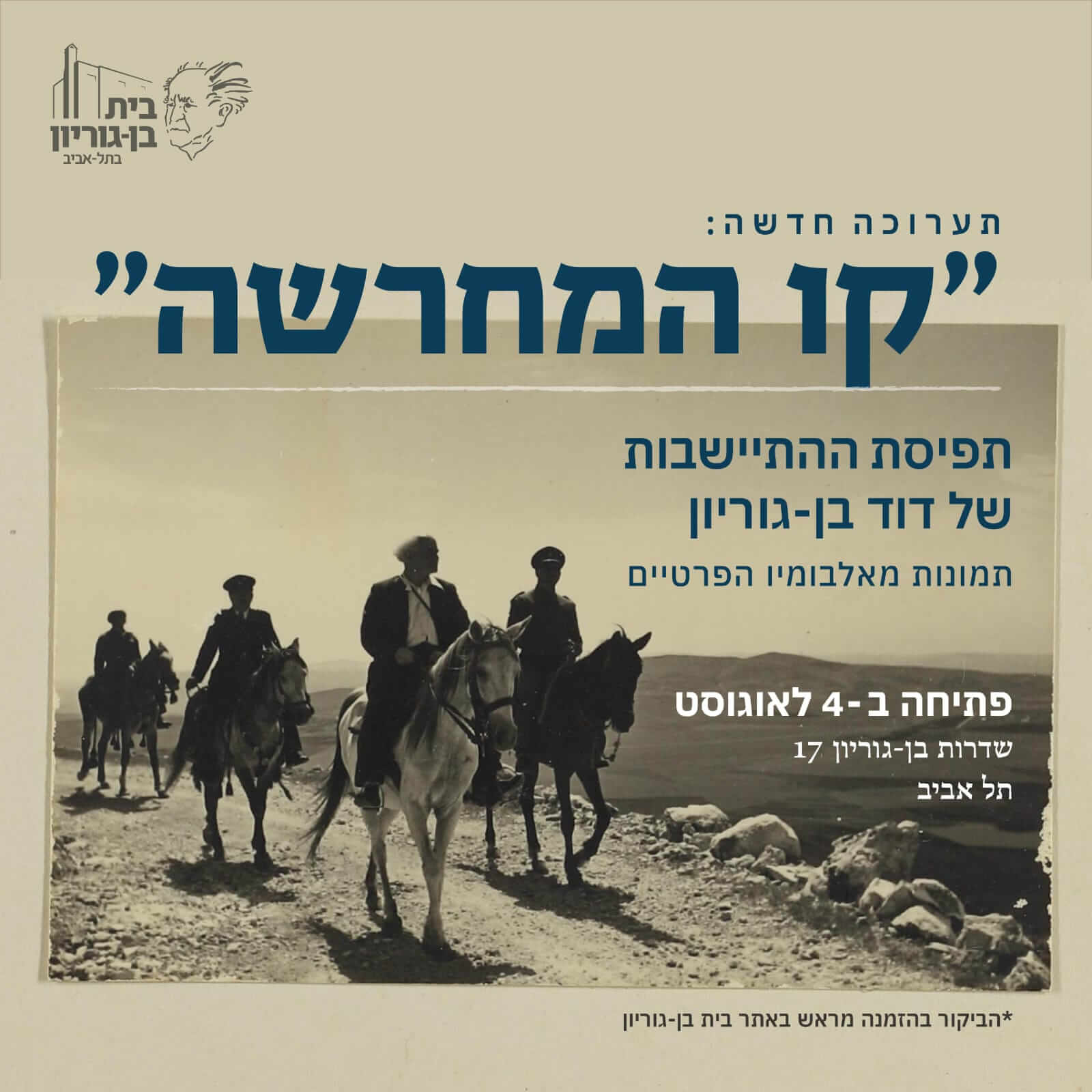
“And we rely on the creative, pioneering spirit that beats in the hearts of our youth, both in the country and in the Diaspora. Such a force has the power to move mountains and make the desert bloom. With the establishment of the State of Israel, the era of pioneering has not ended; on the contrary, it will now rise to new heights and grow stronger than ever before. For the anvil has been found for the pioneering hammer, the abandoned hills of the Galilee, the desolate plains of the Negev, the approaches to Jerusalem, and the seashores, calling out to every brave soul and aspiring spirit: come, and settle among us.” (Government and Its Program, 1949) The exhibition The Plough Line presented David Ben-Gurion’s vision of settlement through photographs and quotations drawn from his private home.
“And we rely on the creative, pioneering spirit that beats in the hearts of our youth, both in the country and in the Diaspora. Such a force has the power to move mountains and make the desert bloom. With the establishment of the State of Israel, the era of pioneering has not ended; on the contrary, it will now rise to new heights and grow stronger than ever before. For the anvil has been found for the pioneering hammer, the abandoned hills of the Galilee, the desolate plains of the Negev, the approaches to Jerusalem, and the seashores, calling out to every brave soul and aspiring spirit: come, and settle among us.”
(Government and Its Program, 1949)
For Ben-Gurion, settlement was far more than a physical act, it was a cornerstone of national security for the Jewish community and, later, for the State of Israel. At the same time, he viewed it as a driving force for economic development and as a vital foundation for building a just, cohesive society.
The exhibition featured rare historical photographs from his home, illustrating his vision of settlement in all its dimensions.
You are invited to explore the digital album, showcasing the photographs displayed in the exhibition:
Ben-Gurion’s Vision of Settlement Along the Borders
Ben-Gurion’s Vision of Settlement Along the Borders “borders Defensible Borders defense” is a consept describing perception territorial according to condition basic for its existence of country is to establish את her borders in a way to let it her defense herself of enemies current and future, without context of the existence of agreements peace such and others wit countries who borders with her. Ben-Gurion believed that a country must be able to defend itself independently of external agreements. From its earliest days, Israel’s borders were not peaceful, and the responsibility to protect them rested on both the military and civilian presence. Settlement along the borders was therefore essential, not only as a means of inhabiting the land, but as a first line of defense, with communities capable of sustaining and protecting themselves in times of conflict. , The need arose to build settlements capable of defending themselves in the event of an attack.
Settlement as Foundation: While borders may be shaped by war and diplomacy, Ben-Gurion argued that they have no lasting meaning without settlement. Beginning in the 1930s, initiatives such as the “Tower and Stockade” settlements laid the groundwork for establishing facts on the ground. In the 1940s, projects like the “11 Points” in the Negev played a decisive role ahead of international deliberations, helping secure key regions within the 1947 Partition Plan. These settlements continue to underpin Israel’s borders to this day.
A National Mission: israel is one of the smallest countries. at the end of the Independence war its area was 20,770 kilometer“”Rר that they כ-77% its area of land israel the mandatory period (כ-27,000 kilometer“”Rר). territory of Mandatory Palestine, and was home to roughly one million people . In the years that followed, some 1.5 million immigrants arrived. Absorbing them, providing housing, employment, education, and healthcare, became a central national mission, closely tied to the expansion of settlement across the country..
Agriculture: Ben-Gurion defined two primary goals for agriculture:: to provide food for the population, and to contribute to the economy through exports, and to establish a physical presence on the land. , Inspired by well-known Joseph Trumpeldor’s idea20: “that the plow defines the nation’s borders he saw agricultural work as both
an economic necessity and a nationalact of sovereignty.
Community and Resilience: Life along the borders has always presented significant challenges.. From the earliest days to the present,–residents of these areas have faced ongoing security and social pressures.. In response, they developed strong, supportive communities built on mutual responsibility.. These communities have, played a vital role in strengthening. personal resilience and sustaining life along Israel’s frontiers.

