
“And we rely on the creative pioneering force beating in the hearts of our youth, both in the country and in the Diaspora, and such a force has the power to move mountains and make the desert bloom. With the establishment of the State of Israel, the era of pioneering has not passed; on the contrary, from now on it will make waves, glorify, and strengthen like never before. For the anvil has been found for the pioneering hammer—the abandoned hills of the Galilee, the desolate plains of the Negev, the ruined approaches to Jerusalem, and the seashores calling to every brave soul and adventurous spirit: come, and settle among us.” (Government and Its Program, 1949)
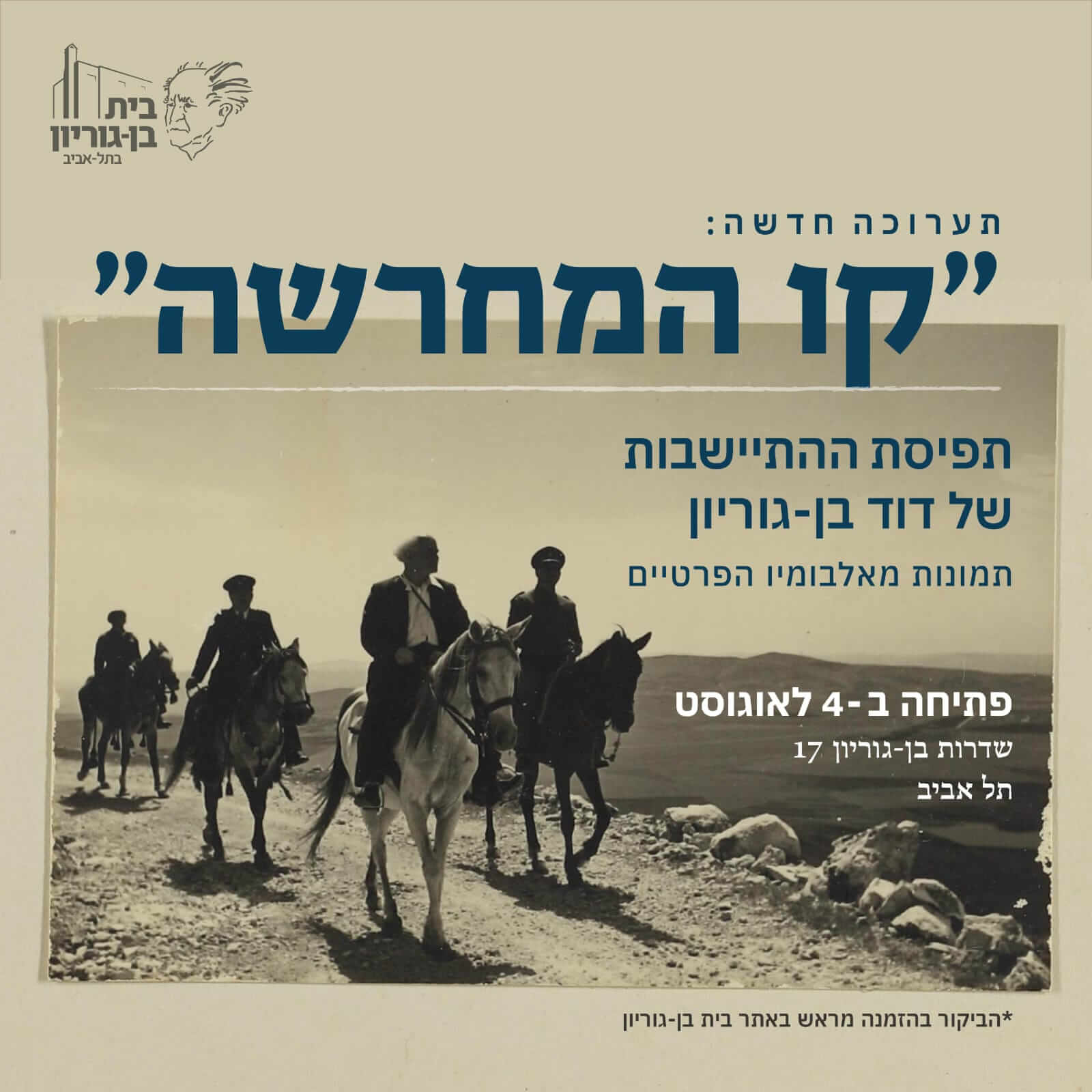
An exhibition presenting private photographs of Ben-Gurion alongside his political, security, and social vision regarding the question of the country’s borders.
“And we rely on the creative pioneering spirit beating in the hearts of our youth, both in the country and in the Diaspora, and such a force has the power to move mountains and make the desert bloom. With the establishment of the State of Israel, the era of pioneering has not ended; on the contrary, from now on it will make waves, glorify, and strengthen like never before. For the anvil has been found for the pioneering hammer—the abandoned hills of the Galilee and the desolate plains of the Negev, the ruined approaches to Jerusalem, and the seashores calling out to every brave soul and ambitious spirit: come, and settle among us.” (Government and Its Program, 1949
The exhibition “The Plow Line” presents, through photographs and quotes from David Ben-Gurion’s private home, his vision of settlement as he defined it. Ben-Gurion saw settlement as a tool for the national security of the Jewish community and, later, of the State of Israel. Moreover, he believed that settlement also served as a means for economic development and as an integral part of building the Jewish nation into a just and cohesive society. The exhibition features historical photographs from Ben-Gurion’s home that illustrate his vision of settlement in all its dimensions.
You are invited to browse the digital album, which includes the collection of photographs from his private home that were displayed in the exhibition.
Ben-Gurion’s view on the settlement of the country’s borders:
Security – “Defensible borders”: “borders ברי defense” is a consept describing perception territorial according to condition basic for its existence of country is to establish את her borders in a way to let it her defense herself of enemies current and future, without context of the existence of agreements peace such and others wit countries who borders with her. From its first day, the borders of the State of Israel were not peaceful borders. The primary task of the IDF in particular, and of the security system in general, is to protect the country’s borders to ensure the safety of its citizens—especially in a state where the security situation is never stable. , The need arose to build settlements capable of defending themselves in the event of an attack.
Settlement as the Foundation: The borders of the State of Israel were determined through military force and later through written agreements, but they have no meaning without settlement. As early as the 1930s, the Zionist movement recognized the need for settlement and launched the “Tower and Stockade” operations. In the 1940s, the “Three Lookouts” and the “11 Points” were established in the Negev ahead of the UN UNSCOP committee. This settlement ensured that the Jewish state would secure the Negev, the Jezreel Valley, the coastal plain, and parts of central Israel in the 1947 Partition Plan, and it is this settlement that effectively maintains Israel’s borders to this day.
national mission: israel is one of the smallest countries. at the end of the Independence war its area was 20,770 kilometer“”Rר that they כ-77% its area of land israel the mandatory period (כ-27,000 קמ“”r). At that time, the country’s population was about one million citizens. In the following years, another one and a half million Jews immigrated to the country, who needed to be absorbed, provided with housing, and offered services such as a healthcare system and an education system. .
agriculture: David Ben-Gurion set two main goals for agriculture in the Land of Israel.: The first is food production—to feed the country’s citizens and to export local produce abroad., and thus increase the public treasury. The second is marking the border line and establishing facts on the ground. , inspired by his says of Trumpeldor from the begining of the century the20: “in the place where tills plow the Jewish the furrow the last שם mark our borders.”
community life and welfare: Settlement on the country’s border is a complex task. also in these days we see the daily dealing–of Residents of border communities and the challenges posed by living on the country’s borders. One way to cope with these challenges is by developing community life.. Alongside the state’s concern for its residents and the need for national responsibility toward those living along the conflict lines, The residents organized themselves and created communities based on mutual support. and a vibrant community life. From the earliest days of settlement until today, these communities have contributed to strengthening the personal resilience of residents along the conflict lines, as well as reinforcing and expanding the settlements over the years.

