
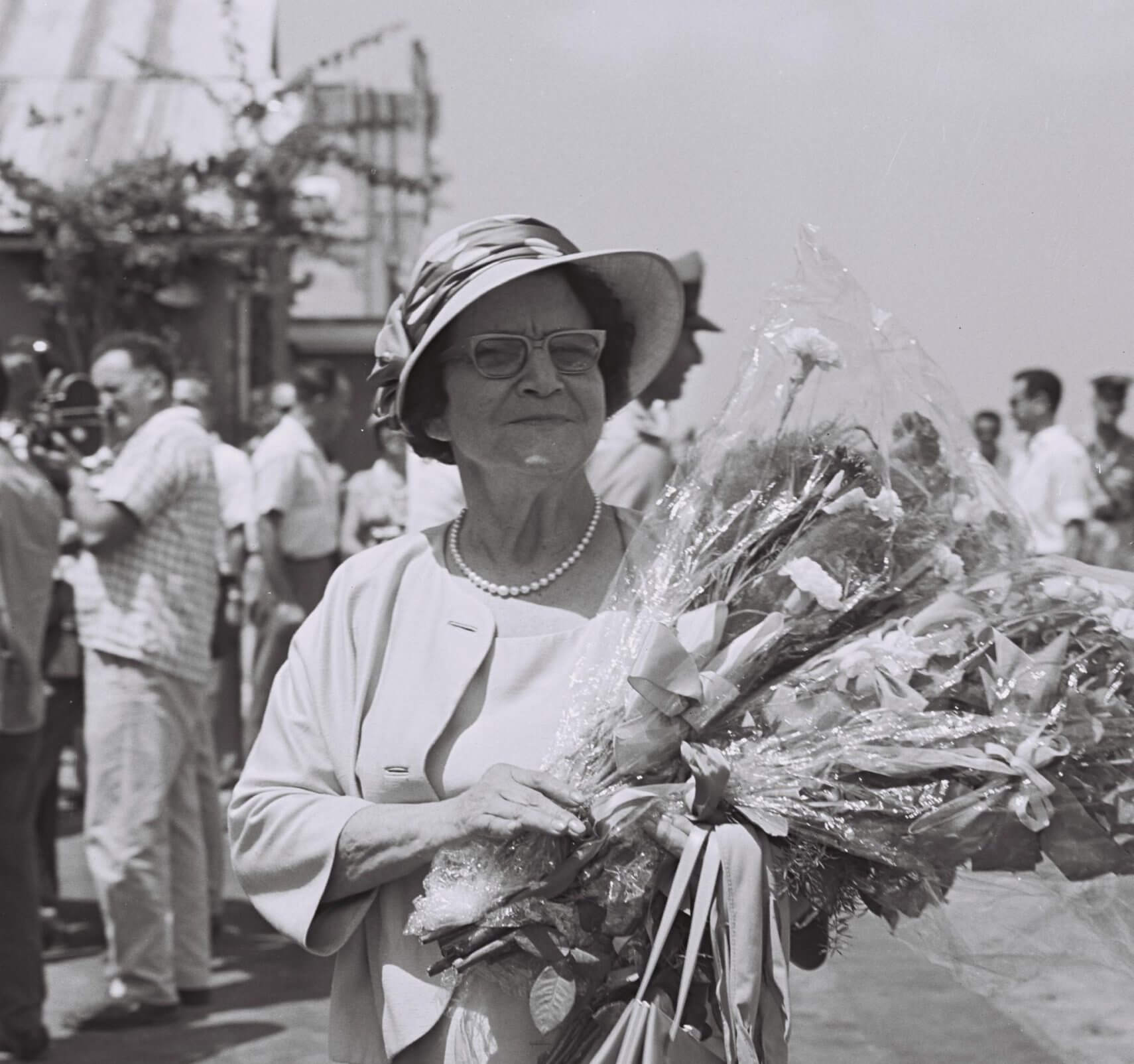
Ahead of the 55th anniversary of her passing, the David Ben-Gurion House and the Na’amat movement established an exhibition in memory and honour of Paula Ben-Gurion, highlighting her life, her relationship with David Ben-Gurion and her distinctive character and personality. The exhibition combined historical artifacts from the Ben-Gurion House collection with artworks created especially for the occasion by art students.
Paula Ben-Gurion (née Munweiss) was born in April 1892 in Minsk, in the western part of the Russian Empire. At the age of 13, she immigrated with her family to New York. After completing high school, she began studying nursing, and upon graduation worked as a surgical nurse at the Jewish Hospital in New York.
In 1916, David Ben-Gurion and Paula met through a mutual friend: “If only you could see his appearance, bleary eyes, worn-out clothes, but as soon as he opened his mouth, you could see he was a great man” (The Woman by His Side, Ilan Ben-Ami, p. 28). Ben-Gurion asked Paula to help him translate texts about the Land of Israel from Yiddish into English. They met several times at the city library, and a love story gradually developed between them. About a year later, on the morning of December 5, 1917, they met at the entrance of City Hall and were married. Ben-Gurion made their marriage conditional on her willingness to move to the Land of Israel.
Paula was an anarchist with a sharp mind and a keen eye for people. She often warned Ben-Gurion about individuals she believed could not be trusted, some of whom later indeed turned against him. She stood by him throughout his life, caring for every detail of his daily routine: ensuring he ate properly, rested when needed, dressed appropriately for each occasion and season, and was shielded from those she considered unworthy of meeting him.
Alongside this, Paula raised the couple’s three children, managed the household finances, and maintained an active social and public life. . She remained deeply engaged with friends and cultural interests, always making time for the intellectual and social pursuits she valued.
Today, when entering the Ben-Gurion House in Tel Aviv, Paula is everywhere: in the stories, in the photographs on the walls, and in the way the house is designed. Yet, at the same time, her presence is completely absent from the public historical space of the house.
On the occasion of the 55th anniversary of her passing, the Ben-Gurion House, in collaboration with the Na’amat organization presented a special exhibition in her memory and honour.
The exhibition took place at the Ben-Gurion House in Tel Aviv and included video works, artistic installations by students, recent photographs of Paula, and a range of accompanying educational activities.
It was curated by award winning filmmaker and artist Yariv Mozar (director and producer of Epilogue) and producer Sigal Rosh.
For the first time, the Ben-Gurion House opened its doors to young creators from diverse fields, inviting them to reinterpret Paula’s story. The aim was to bring her complex and significant figure into focus and give her the recognition she deserves.
The exhibition was structured around five central themes that illuminated different facets of Paula Ben-Gurion’s life:
- Paula the Revolutionary – her connection to Emma Goldman and the anarchist movement
- Paula the Family Woman – mother and partner, responsible for the household and financial management
- Paula by His Side – her correspondence with David, her immigration to the Land of Israel, life in the south, and her influence on his political world
- Paula the Social Figure – her close friendship with Anna Ticho, Sonia Peres, Mira Averbuch, and her public engagements
- Paula the Hostess – from chocolate boxes on the table to her refusal to employ household staff for formal hospitality


